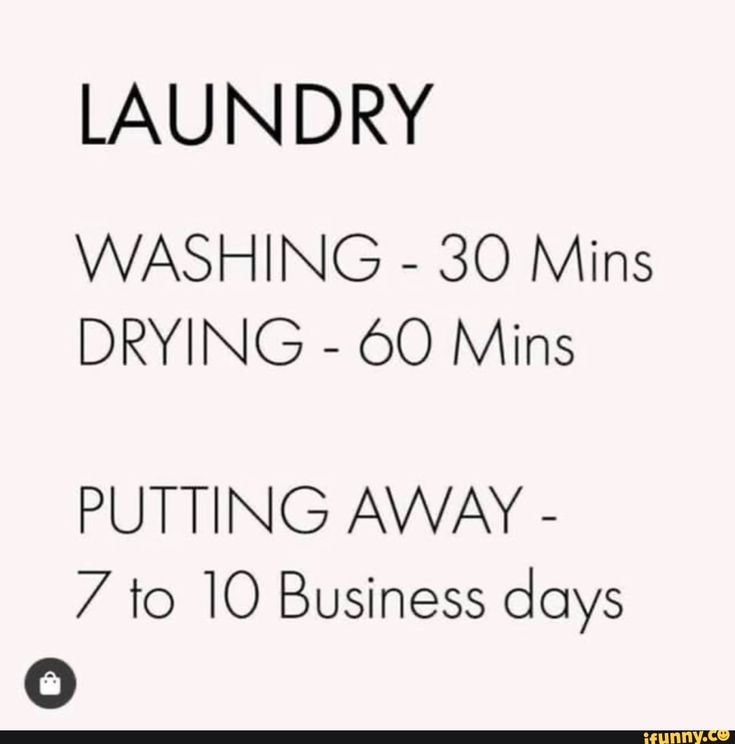
I’m going to jump right in with what might be considered a hot take:
The idea of doing a load of laundry a day — every day — is absolutely, positively, straight up INSANE.
Think about this:
- You wear one set of clothes per day.
- If you’re married, your spouse wears one set of clothes per day.
- If you have a couple of kids, they each wear one set of clothes per day.
I have a decent Samsung washer/dryer set and I’m lucky enough to have it at home. Even then, doing laundry takes a couple of hours per load.
How many of you want to spend 14 hours a week doing laundry? At a minimum?
And why? So your family has the option to wear the same set of clothes two consecutive days in a row? (Because, hey, at least they’re…clean?)
Yeah, I didn’t think so.
Let’s break down where this advice might have come from, what the real problem might be, and some alternative solutions that you might not have thought of…
The Problem: My house is buried under piles of clothes. I’m overwhelmed.
The productivity expert says: The piles of clothes are because you’re trying to do ‘seven’ (or some other high fill-in-the-blank number) loads of laundry every wash day. Break the job down into “smaller bite-size chunks” and distribute that over the week…and there, isn’t that better?
As we all know…no. No, it isn’t!
The Real Problems
- You work full time (or more) and don’t have the time to take on a part-time job on top of that. (And make no mistake, a load of laundry a day — every day — is equivalent to taking on an unpaid part-time job. See the numbers breakdown above.)
- The idea of taking on a task as big as doing a load of laundry a day feels monumental.
- You’re procrastinating.
- You’re not going to do the laundry of your husband/kids/other fill-in-the-blank family member because they promised to help you (or do it themselves).
- You’re exhausted. Whether it’s because of your work, kids, other time conflicts, or a chronic illness — very few people think of doing laundry as the perfect way to unwind after a long day.
Hard Truth #1: You have too many clothes.
Sorry, but it’s true. You look at the pile of clean laundry, then you look at your closet — and it feels like you’re trying to shove a square peg (or more likely, several dozen square pegs) into a teeny, tiny round hole. Then you think about all of those clothes that are already in your closet. “I’ve got plenty of clothes,” you think. “I’ll be okay getting ready for work tomorrow morning. I’ll put that load away…tomorrow. Yeah, I’ll have time tomorrow.”
By now, I’m sure you’re getting the idea.
Chances are, the reason that your clothes are all over the floor is that, at some point in the recent past, you wore those clothes. So here’s the way to start tackling the backlog: every time you pick up a pile of clothes and do a load of laundry (however many times that happens to be in a week) — do that one load all the way to the point of putting the clothes away. But when you put those clean clothes away, do a one-for-one swap:
- Find something that you haven’t worn in you-can’t-remember-how-long,
- Take it off the hanger,
- and put it in a donation box.
- Don’t wait until the donation box is full. Load the box in the car, go to one of those clothing donation bins, and donate everything.
Repeat until you can comfortably put your clothes away without procrastinating.
Hard Truth #2: The only person you have any control over is you.
Hate to break it to you — but if something is bothering you because someone else isn’t doing it, you have two options: 1) you can stew, and simmer, and grumble, and let frustration and bitterness sap you of your happiness and energy, or 2) you can take care of it yourself.
The one exception: Knowing how to do laundry is a life skill that your kids need to know. If you need to be the one to teach them that life skill, talk it over as a family and block out the time for that lesson. Yep. It should go in the calendar like any other family activity. Block out three hours (teaching takes time), help them learn it start to finish, then repeat as necessary until you feel like they’ve learned the lesson.
General Laundry Guidelines
“Maintenance” laundry: My general rule for maintenance laundry is one load of laundry per person per week. (This is just having clothes to wear for the week, not clearing up any backlog or piles of clothes on the floor.)
- That means if there are two of you, you will be doing two loads of laundry per week.
- If there are four of you, you will be doing — you guessed it — four loads of laundry per week.
- If there are seven of you in the house, then doing a load of laundry every day makes sense. But honestly? If there are seven of you in the house, the chances of you coming to me for laundry advice are slim to none, anyway!
How you break this up will depend on your schedule and your access to a washing machine. If you work from home with a laundry room that has a washer and dryer, then you will probably be able to throw a load in during work breaks. On the other hand, if you have to throw everyone’s clothes into a laundry bag and haul it down to the laundromat, you will probably have to plan on spending three hours at the laundromat on the weekends (but more on this later).
Wait, what about separating darks and whites / ironing / dry cleaning, etc. etc. etc….? Separating darks and whites is based in the idea that you need to wash your dark clothes in cold water but you need to wash your whites in hot water. A lot of this was based in effectiveness (or lack thereof) of the washing detergents of the past. Nowadays? Unless you’re washing a bright red dress for the first time (and you’re worried about it turning your white blouse pink), then just set your washing machine to cold water and don’t worry about the rest. Of course, the other option would be to dedicate one day to washing everyone’s dark clothes, one day to washing everyone’s light clothes, etc. But with the notable exceptions of sheets (which tend to get tangled up around clothes when washed in the same load) and towels (which often need to be washed in hot water to kill bacteria/germs), then if you’re desperate enough to be looking for laundry advice from me, fill the washer, throw in a detergent pod and hit start. Worry about the rest when the habit is settled into your routine.
Okay, the dryer is done. Now what?
One of the reasons that I love the meme at the top of this post is because folding and putting away the laundry is the part of the chore that everyone dreads the most. And it’s not all that surprising — the washer and dryer are mostly hands-off processes where the machines do the work for you. But folding and putting away the clothes? That’s up to you.
(I’ve been looking for years to find a robot that will fold your clothes for you. Unfortunately, the few solutions I’ve found are old prototype machines where the business never went anywhere or commercial machines that are massive and far too expensive to even think about recommending. Sorry!)
However, how you fold your clothes — and where and how you store your clothes — can do a lot to make the process quicker and easier. It could even make it easier to get dressed in the mornings.
A few ideas to get you started:
The SockDock: The only reason I don’t have these in my house yet is because I don’t wear socks that often. (I’m in Florida; I’m barefoot or in sandals 99% of the year.) However, this is genius. Each person has two docks: one for dirty socks and one for clean socks. The clean dock hangs in your closet and you find a place for the dirty sock dock that works for you. You pick a pair of clean socks for the day from the clean sock dock, then you attach the dirty socks to the dirty sock dock when you’re getting ready for bed. The dirty sock dock then goes in the wash — socks and all — on laundry day, then gets hung up as the clean sock dock once it comes out of the dryer. You can have up to 9 pairs of socks on a dock at any one time. Definitely recommend this even if I’m not using it myself. (If you do use the sock dock, though, post your experience with it in the comments!)
Dump and Go: Who said you had to fold every piece of your clothing? Granted, there are some things that wrinkle to the point of being unwearable (which you should probably consider donating anyway — see decluttering method above), but things like underwear, sports bras, etc. — the only essential reason that those might need to be folded is to make sure that you have enough space in an already crammed drawer to add just…one more…pair…of boxers…
But if there’s enough space in your drawer — think about adding a couple of small baskets (I’m a big fan of this set from Walmart) and just separating things that way. I’ve done that with my swimsuits (which I happen to have quite a few of, because, well, Florida). And instead of figuring out how to fold those things and keep them folded up in one location — I just throw them all in two baskets (one for tops and one for bottoms) And. It’s. Done.
Outfit plan while you fold:
I hated picking out my outfits for the longest time. I was one of those people who would look into a messy closet and feel like I had nothing to wear. And waking up feeling like I wanted to go back to sleep again did nothing to help matters. In that situation, most ‘lifestyle’ and ‘efficiency’ experts would tell you to pick out your outfit the night before.
Yeah. That takes a level of discipline many of us don’t have. I sure as hell don’t.
Then it hit me: when is the one main time during the week that most of us think about our clothes? Laundry day. What if I planned my outfits as I was putting them away instead of putting them away in ‘clothing categories’ just because that’s the way the stores do it?
Below, I’ve collected a few good ways of ways of doing exactly that.
- Bag ’em and tag ’em: This was the the first process I used when I started doing this. It works best for outfits that don’t require hangers but don’t roll particularly well (sweaters and blue jeans, khakis that wrinkle, etc.). Put together a complete outfit: top, pants, socks, undergarments, etc. Pack the outfit in a storage bag. (You could use a one gallon bag for kids’ outfits or if you’re a fairly small size yourself, but that 2.5 gallon bag I linked to should work best for most people.) Push the air out of the bag and seal it. (Or if you’re really short on space (and don’t mind potential wrinkles) get a set like this from Amazon and suck all of the air out with your vacuum.) In the morning, all you have to do is open the bag and pull out your complete, coordinated outfit. When you’re traveling, this technique has the added advantage of a traveling ‘clothes hamper’: when the outfit is no longer fit to be re-worn, pack it up and seal the bag — no worry about the ‘dirty clothes smell’ affecting the rest of your suitcase.
- The suit hanger and drawstring bag: This is less of a ‘trick’ and more of bundling idea. Find some small drawstring bags (these would work, but there are tons of options out there) and use them to hold your undergarments and accessories (and socks, when appropriate). Hang the bag on your clothing hangar. When necessary, either fold your pants/skirt and drape them over the bar of the suit hangar or daisy-chain your hangars together using the pop top from a beverage can.

- The skivvy roll: I’ve never used this technique, but I’ve seen it done and it does work — if you wear crew-length (or longer) socks. Find all the information you want on this technique here.

- The Army T-Shirt Roll: This is another technique I discovered through Pinterest. (Find the instructions on how to roll your shirts in a YouTube video here.) I found that when I flat-folded my pants and placed them in the center of my shirts (along with my undergarments) before I rolled them, I was able to easily roll a complete outfit together for storage.

The difference between smart ‘laziness’ (what most people would call ‘efficiency’) and just outright laziness is often one thing: creative problem solving. I’ve found it to be a rare thing when the ‘traditional’ way to solve a problem was also the best way to solve that problem. Sometimes you’re much better off if you think outside the box. Or in this case, the dresser.
So what about you guys? Any other good tips for saving time and energy when it comes to your clothes? Leave them in the comments below!

 Virtual Homemaker
Leave a comment